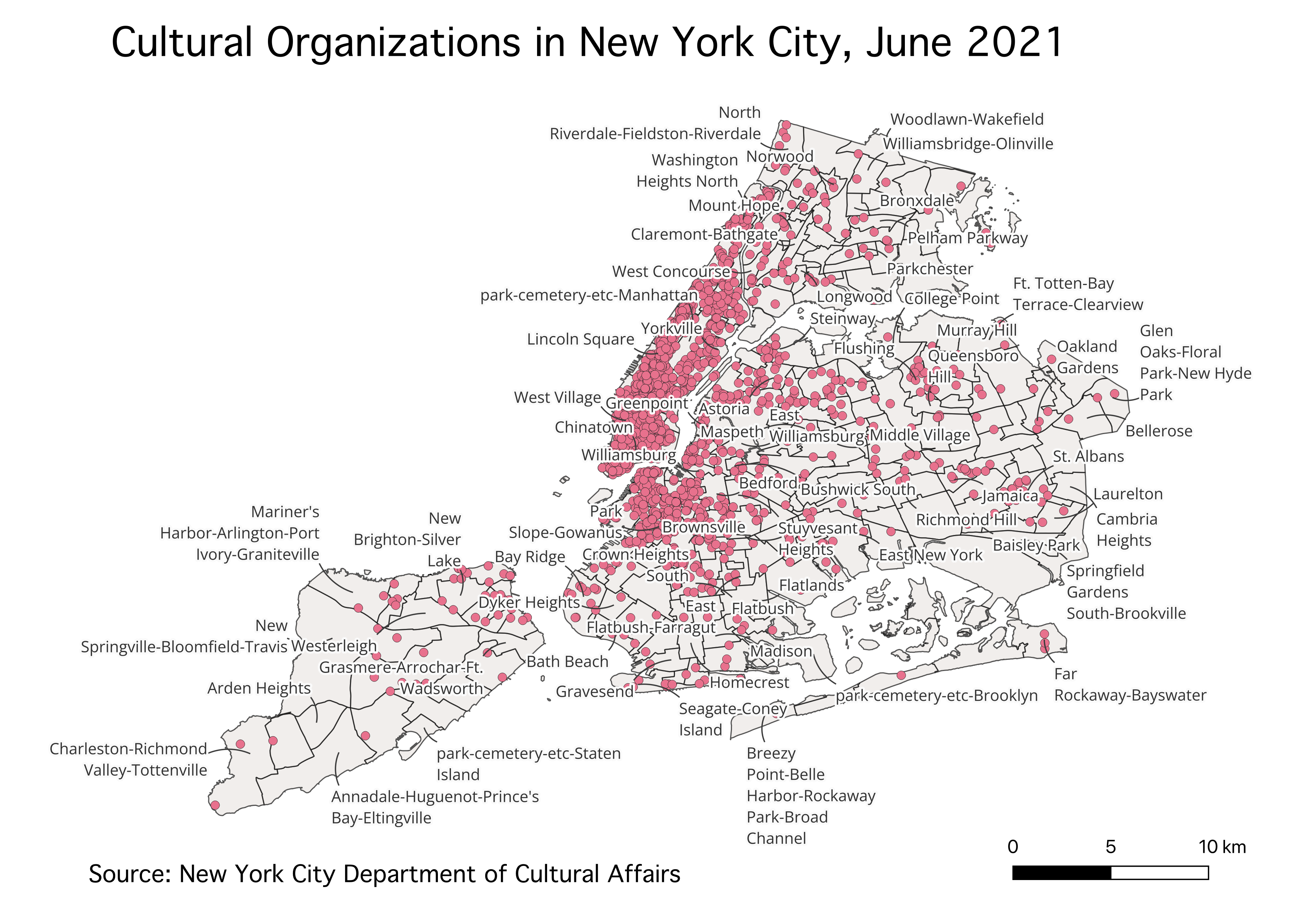
Despite extensive research on spatial access to social services, scholars tend to overlook cultural organizations as an indispensable part of network ties. Access to cultural resources is particularly important for newcomers to navigate and reshape social boundaries. This study explores the spatial dimensions of cultural organizations at the neighborhood level in New York City, which we conceptualize as “cultural accessibility”. Using spatial analysis and regression models, we specifically focus on the intersection of neighborhoods’ ethnoracial composition and concentrated immigration. Our findings show that higher immigrant concentration reduces access in White neighborhoods, but in Hispanic and Asian neighborhoods, it increases access. We also find that Black neighborhoods exhibit lower cultural accessibility, which is explained largely by socioeconomic status and residential mobility. Our study furthers the understanding of spatial inequalities in cultural access and advocates for greater attention to its role in immigrant assimilation and integration.
Locations of cultural organizations in New York City