Vanishing Restaurants, Unequal Spaces
Ethnic and Spatial Disparities in New York City’s (Post-)COVID Restaurant Closings
December 1, 2025
This study investigates the spatial patterns of restaurant closings in New York City during and after the COVID-19 pandemic, specifically the anti-Asian bias in space. While prior research has documented the pandemic-related bias against Asian restaurants, its impact on actual closures and their underlying neighborhood context remains underexplored. Drawing on restaurant inspections, open restaurant applications and the American Community Survey, I construct a novel dataset to analyze the likelihood of closure by restaurant’s Asianness and its interaction with neighborhood’s ethnoracial composition. Employing multilevel logistic models and spatial lag models, I found that Asian restaurants were more likely to close during the pandemic, which mostly occurred in predominantly minority neighborhoods. In a post-pandemic era, although there was no significant association between closure and restaurant’s Asianness, Asian restaurant closings remained consistently higher in predominantly Asian neighborhoods. Furthermore, across both eras, higher concentrated immigration predicted Asian restaurant closings; greater neighborhood affluence and residential stability were linked to fewer closings; public transportation accessibility mitigated pandemic closings. These results shed light on the anti-Asian effect on Asian restaurants during the pandemic, the spatial concentration of ethnic businesses, and the neighborhood dynamics shaping urban foodscape.
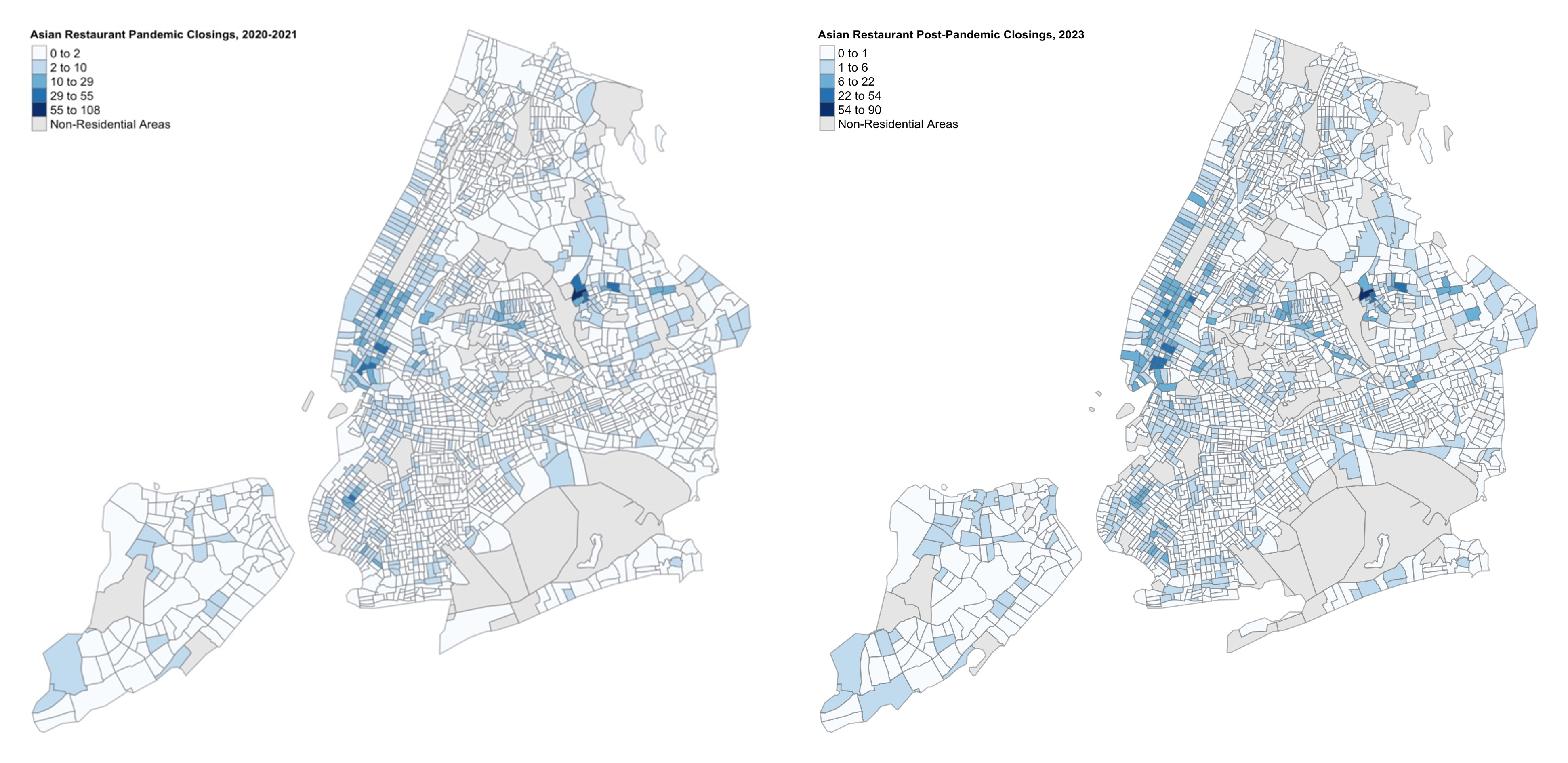
Spatial distribution of Asian restaurants during and after the COVID-19 pandemic
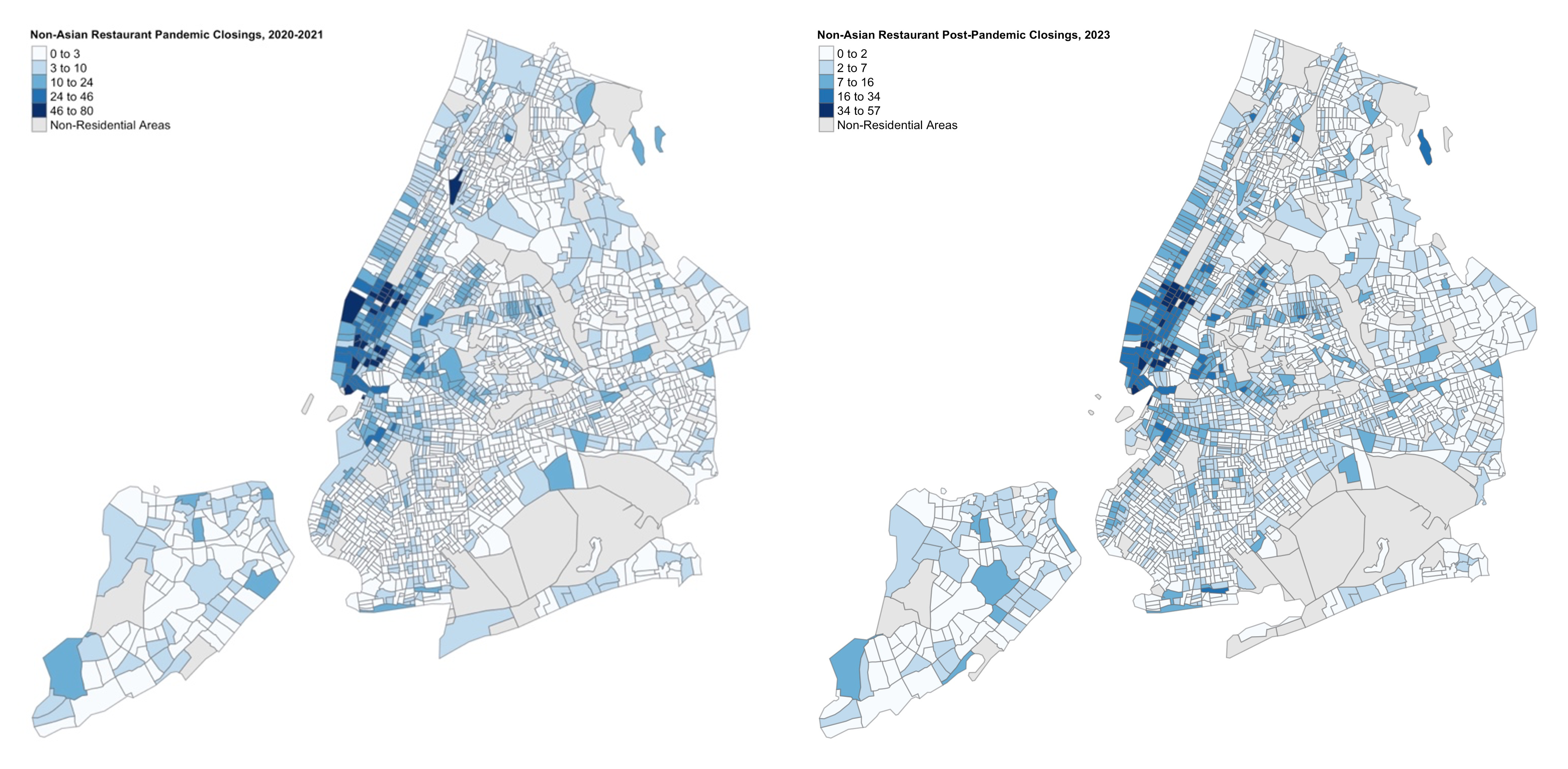
Spatial distribution of non-Asian restaurants during and after the COVID-19 pandemic