Vanishing Restaurants, Unequal Spaces
Racialized Stigma and Co-Ethnic Concentration on Restaurant Closings in New York City
May 31, 2026
How do racialized stigma and co-ethnic concentration shape ethnic restaurant closings in space? This study investigates this question through the case of Asian restaurants in New York City during and after the COVID-19 pandemic, where anti-Asian discourse provides an empirical setting. While prior research has documented anti-Asian bias against Asian restaurants during the pandemic, its impact on actual closures and the underlying neighborhood context remains underexplored. Drawing on restaurant inspections, open restaurant applications and American Community Survey, I create a novel dataset to capture restaurants’ operating status and neighborhood context. I examine how the two mechanisms—racialized stigma and co-ethnic concentration—operate at different scales. Using multilevel logistic models and spatial lag models, I find that Asian restaurants were more likely to close during the pandemic, but this effect did not persist in the post-pandemic period. In contrast, Asian restaurant closings remained concentrated in predominantly Asian neighborhoods across both periods. Neighborhood affluence and residential stability were linked to fewer closings, while immigrant concentration was associated with greater ethnic restaurant loss. These findings show that stigma is crisis-specific, whereas co-ethnic spatial vulnerability is structural and persistent, highlighting how business survival is shaped by the broader patterns of urban inequality.
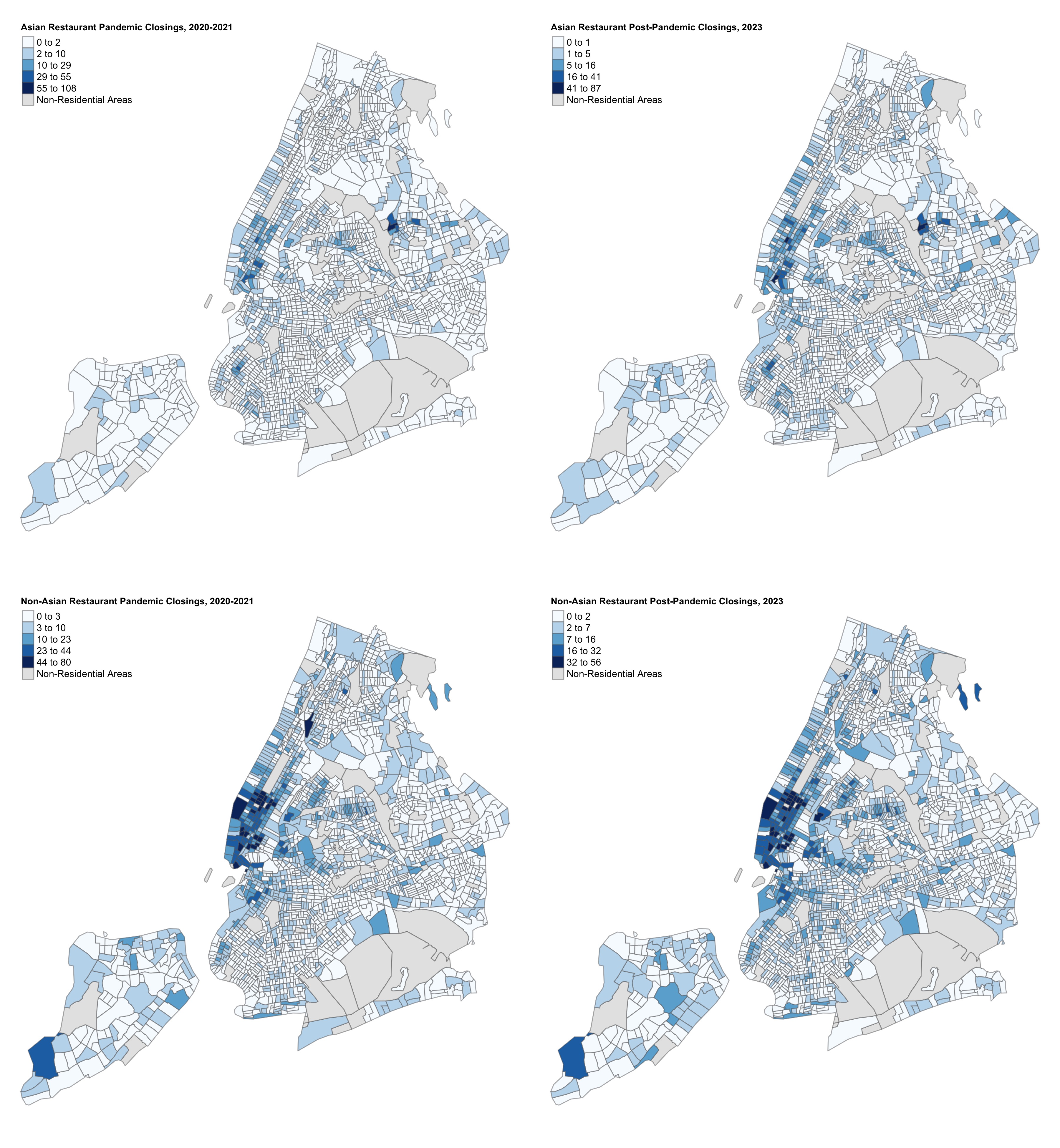
Spatial distribution of restaurant closings
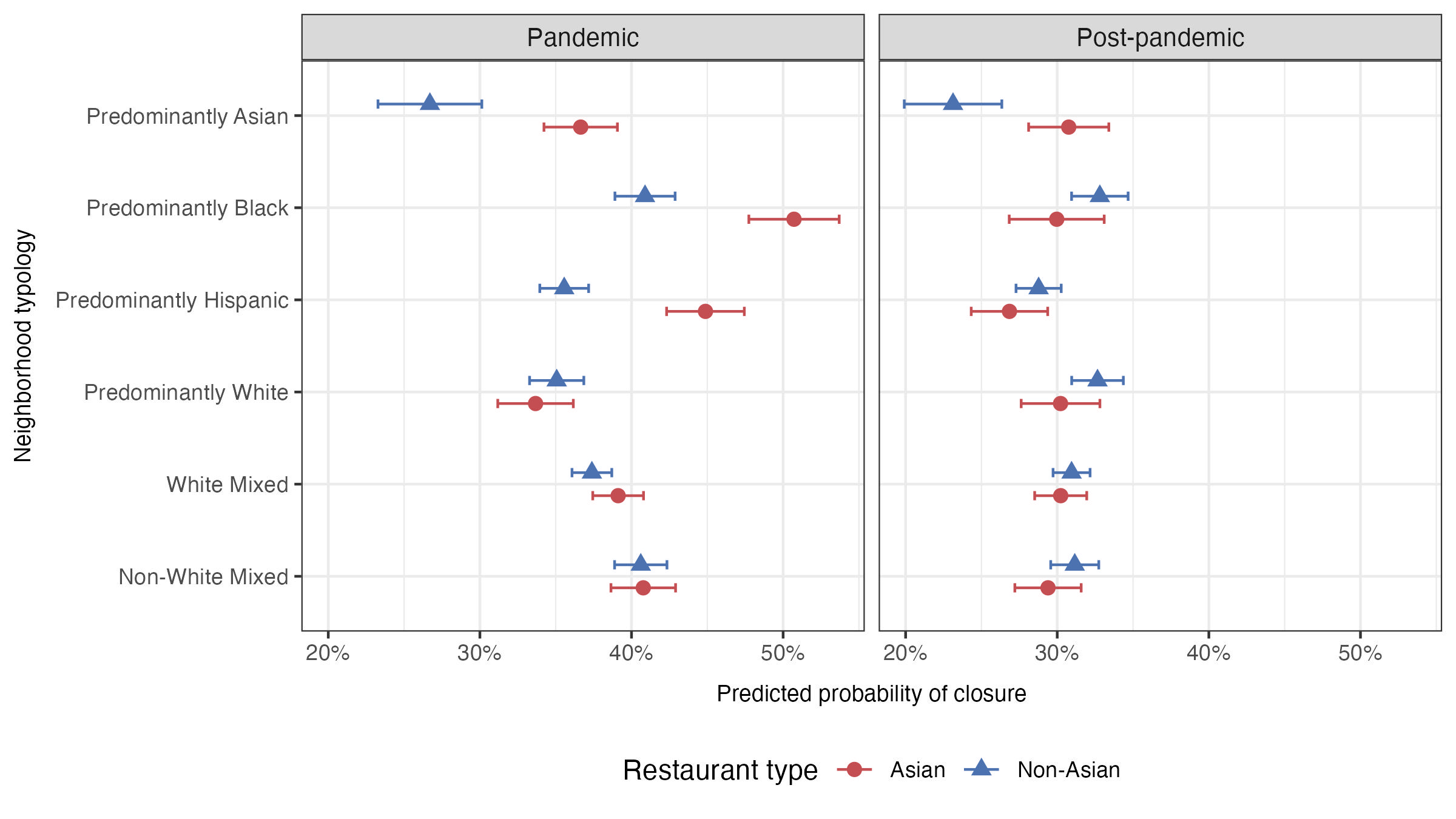
Predicted probability of restaurant closure risk
- Posted on:
- May 31, 2026
- Length:
- 1 minute read, 207 words
- Categories:
- urban immigration COVID-19
- Tags:
- spatial